

Intellectual property
Digital Notarization Platform
Protect Your Intellectual Property with Blockchain
A solution to notarise graphic designs, photographs, artwork, patents, and documents securely, simply, reliably, and with certification. It creates a blockchain audit trail that is secure, immutable, and verifiable.
Simple, Easy, and Secure Notarization Solution
Blockchain Technology for Businesses
Egomnia and OwnYourBusiness have developed a simple and innovative application for notarising and certifying any digital file on the blockchain, including contracts, minutes, logos, images, NDAs, patents, scientific articles, certifications, and resumes.
Ylium blockchain Solution
Ylium: Notarize and Protect Your Files
Blockchain Applications in Business
Procurement: Used for managing supplier qualifications, creating and storing contracts, and handling purchase orders, ensuring transparency and efficiency in commercial transactions.
Legal Sector: Employed for the security and storage of legal documents such as Non-Disclosure Agreements (NDAs), contracts, agreements, patents, and logos, ensuring they are protected and easily accessible.
Training: Applied to documentation and verification of know-how, skills, competencies, as well as certifications or professional qualifications, helping to maintain high standards of training and expertise.
Marketing: Utilized for the dissemination and storage of press releases, updates, video content, and graphic materials, facilitating effective management of marketing resources and corporate communication.
Supply Chain: Adopted to enhance product traceability throughout the supply chain, from production phases to suppliers, increasing transparency and reliability for consumers.
Practical Applications of Blockchain in Business
Art: Blockchain is used in the art world primarily for the authentication and provenance of artworks. This system creates an immutable digital record for each piece, ensuring the integrity of information related to authenticity, ownership history, and provenance. It is also particularly useful for managing copyright and facilitating secure buying and selling of artworks.
Healthcare: Blockchain can enhance medical records management by ensuring data security, privacy, and accessibility. Patients retain control over their data and can securely grant access to healthcare professionals. This system also facilitates the traceability of pharmaceuticals from manufacturer to patient, reducing the risk of counterfeiting.
Energy: In the energy sector, blockchain supports the development of distributed energy networks, enabling secure and transparent renewable energy transactions between producers and consumers. This can promote the use of renewable energy and support sustainability initiatives.
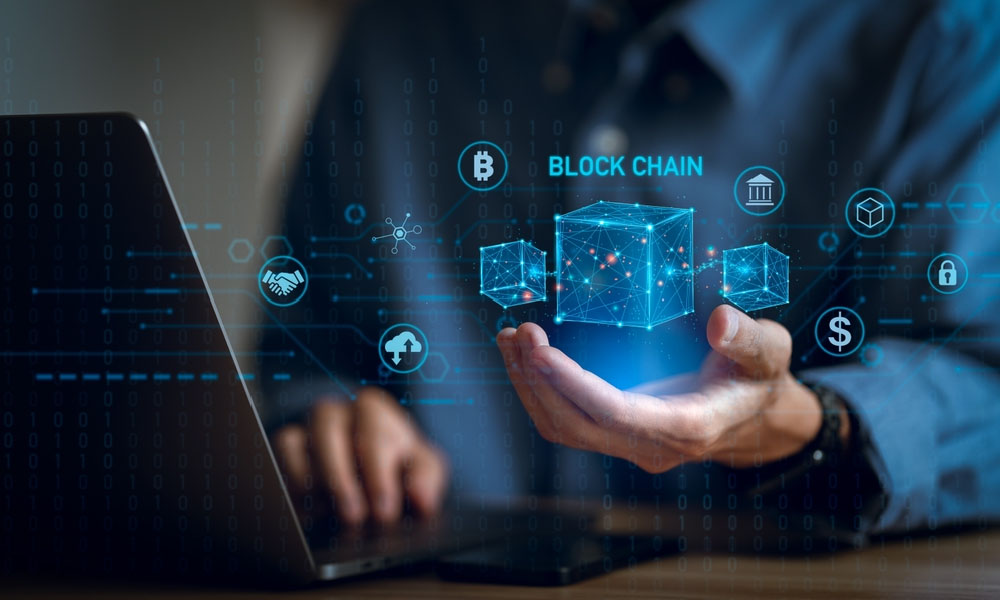
Use Case of Blockchain for Businesses
Insurance: In the insurance sector, blockchain automates claims and policies through smart contracts, enhancing operational efficiency and reducing the risk of fraud. This system also provides greater transparency and traceability between insurers and policyholders.
Logistics and Transportation: Blockchain optimises logistics by tracking the real-time movement of goods, reducing operational costs and improving supply chain efficiency. This system increases transparency for all parties involved, from suppliers to end consumers.
Real Estate: Blockchain streamlines real estate transactions by reducing the time and cost of verifying property titles. It enables comprehensive management of sales contracts and title transfers, making the process more transparent and less susceptible to fraud.

FAQ
Frequently Asked Questions
Want to learn more? Here are some useful answers on how to use blockchain in your sector and business.
What can be done with blockchain?
Ensure transparency and immutability of data and documents such as contracts.
Improve the security of digital transactions.
Simplify product traceability in the supply chain.
Authenticate digital identity securely.
Why is blockchain secure?
Blockchain is secure because it uses cryptography to protect data, operates on a decentralised system that eliminates single points of failure, and maintains an immutable ledger that prevents modification of information once recorded. This ensures transparency and resistance to tampering.
Who benefits from blockchain?
Businesses: To optimise transactions and supply chains.
Consumers: To verify the authenticity and provenance of products.
Healthcare Sector: To protect patient data.
Artists: To protect rights over digital artworks.
Insurance: For automation and management of claims to reduce fraud.
Logistics: For increased efficiency and traceability. Blockchain is critical for those seeking reliability and innovation in their systems.
What is blockchain in simple terms?
Blockchain is commonly described as a “chain of blocks.” It is a decentralised computer system consisting of a network of nodes that collectively manage a public ledger. This ledger, composed of a chain of data and information such as transactions, is maintained securely and transparently without a central authority.
🧩 INTELLECTUAL PROPERTY & BLOCKCHAIN VALUE MATRIX — YLIUM INTEGRATION
| Regulation / Framework | Scope & Legal Reference | Blockchain Role (Ylium Function) | Ylium Benefit for IP Protection | Business Impact |
|---|---|---|---|---|
| WIPO – World Intellectual Property Organization | International protection of IP rights under Berne & Paris Conventions | Ylium notarizes works, designs, and patents with immutable timestamps | Provides verifiable proof of creation and ownership | Strengthens legal evidence in disputes and IP filings |
| EUIPO – European Union Intellectual Property Office | Manages trademarks, designs, and copyrights in the EU | Ylium integrates a blockchain certificate of originality linked to each digital work | Simplifies proof of ownership for EU IP registration | Reduces registration time and cost for innovators |
| Berne Convention (1886) & TRIPS Agreement (1994) | Protects literary, artistic, and scientific works internationally | Blockchain acts as a global register of creative ownership | Ensures international recognition of creation date | Facilitates cross-border copyright enforcement |
| Digital Copyright Directive (EU 2019/790) | EU directive for online content protection and fair remuneration | Ylium NFT system certifies authorship and licensing rights | Enables transparent royalty tracking and smart licensing | Creates new digital rights management (DRM) models |
| Patent Cooperation Treaty (PCT) | Harmonized patent application system | Ylium notarization certifies prior art and R&D documentation | Establishes verifiable innovation traceability | Simplifies proof of “first to file” and prevents IP conflicts |
| ISO 56005:2020 – Innovation Management | Guidelines for IP management within innovation processes | Ylium Core logs R&D steps and design iterations immutably | Supports IP audits, ISO certification, and innovation governance | Reduces risk of internal IP loss or misappropriation |
| GDPR & Data Act (EU) | Data ownership and transparency in digital assets | Ylium SSI / ID manages ownership and access rights to digital creations | Ensures privacy and control over intellectual property metadata | Secure distribution of IP with traceable access permissions |
| UNCITRAL Model Law on Electronic Transferable Records (MLETR) | Recognition of digital transferable documents | Ylium NFT allows tokenization of digital assets as transferable IP certificates | Turns IP rights into tradable digital assets | Enables new business models: tokenized art, patents, licenses |
| AI Act (EU 2024) | Regulation of AI-generated content and accountability | Blockchain ensures traceability of AI-generated works | Certifies human authorship vs. algorithmic creation | Protects creators and companies using generative AI tools |
| ESG / SDG 9 – Innovation & Infrastructure | Encourages fair, transparent, and sustainable innovation | Polygon-based Ylium ensures green and ethical certification | Demonstrates responsible and sustainable IP management | Boosts brand reputation and access to innovation funding |